
Making a bottle is only half the experiment. Eventually, it has to go into a glass.
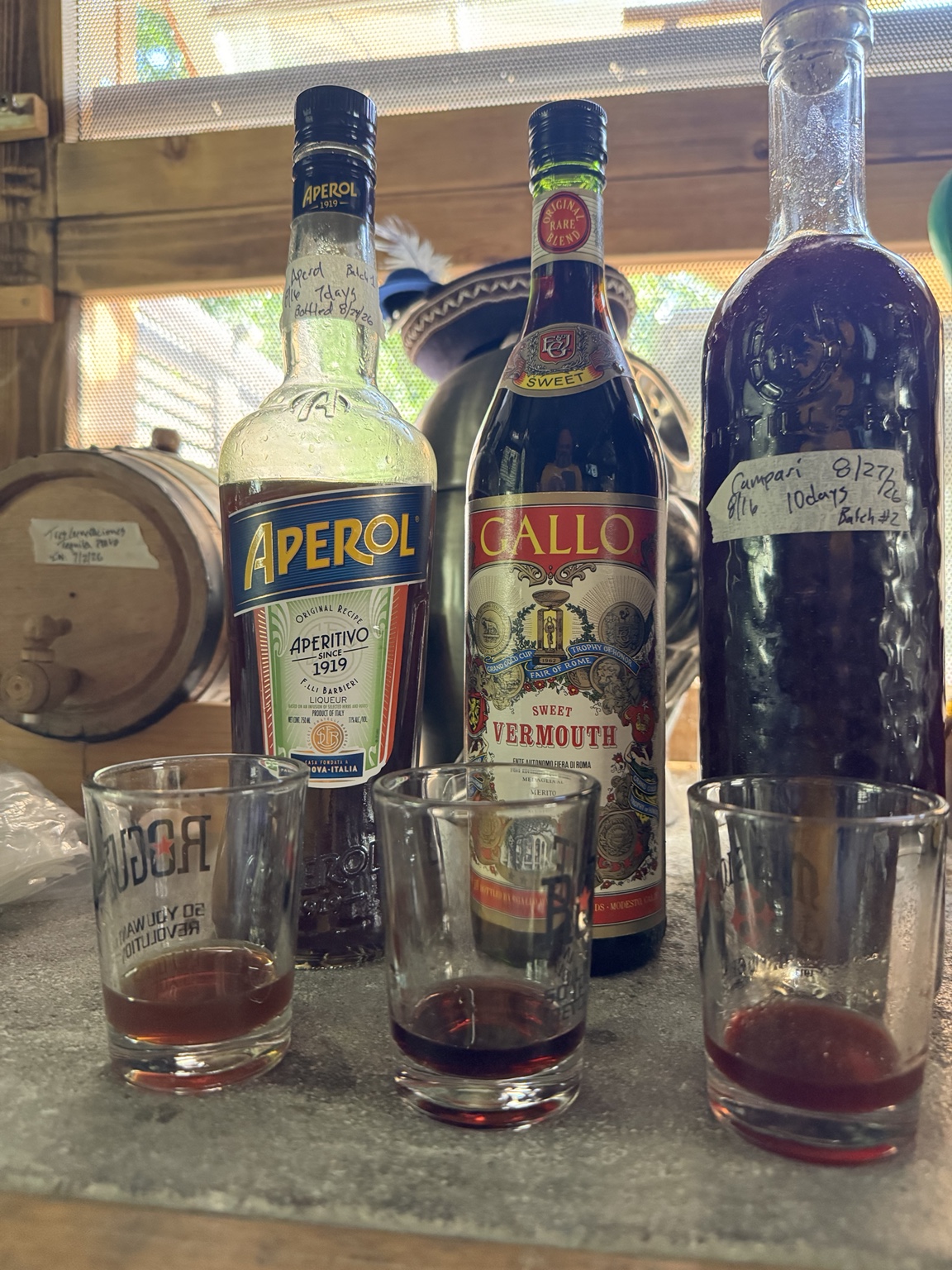
After several days of rest, I tasted three recent Brewshed batches side by side: homemade Aperol, sweet vermouth, and Campari. The goal was not simply to decide whether they tasted good. I wanted to understand what each bottle was doing, and whether it performed its intended job in a finished drink.
All three were tasted first near room temperature and then again after chilling and dilution. The Campari and vermouth received one additional test: a Boulevardier built with our barrel-aged house whiskey.
That final drink changed the conclusion.
The Aperol
The homemade Aperol was reddish-brown rather than commercially bright orange. Its aroma and flavor were distinctly floral, with orange, rose, and vanilla layered together.
The vanilla was noticeable without becoming dominant. It sat underneath the citrus and flowers, softening the drink and giving it a fuller texture. The Aperol felt slick on the palate and finished cleanly.
Chilling and dilution changed it considerably. Grapefruit became more apparent, but the perceived sweetness also increased. The colder sample was brighter and more citrus-forward, though less restrained.
The bottle is promising on its own, but its real test is still ahead. An Aperol spritz will show whether the grapefruit, rose, and vanilla remain distinct once sparkling wine and soda are introduced.
The sweet vermouth
The vermouth may be the most naturally balanced of the three.
It poured a deep red and immediately presented itself as wine rather than as a botanical extract wearing a wine costume. Burgundy-like fruit led the profile, with layers of restrained bitterness underneath it.
The finish carried a pleasant bitter-orange-peel character. It was not bracing, and it did not need to be. The bitterness provided definition without overpowering the wine.
It was also quite drinkable straight.
Chilling made the vermouth brighter, but also thinner. Dilution softened the bitterness and removed some of the depth that made the room-temperature sample so compelling. This is a vermouth that seems happiest near room temperature or only lightly chilled.
The Campari
The Campari was unmistakably beet red. Aggressively, almost comically beet red.
Its aroma leaned toward sweet orange. On the palate it was sweet-forward, with mild bitterness and no detectable off flavors. It was approachable and easy to drink, but noticeably softer than commercial Campari.
Chilling and dilution did not uncover a hidden bitter backbone. The drink remained sweet, with only subtle bitterness on the finish.
At first, that seemed like the batch's central problem. Had I made something pleasant that no longer performed like Campari?
The answer required a cocktail.
The house Boulevardier
The Boulevardier was built with:
- 2 ounces of house whiskey, Old Forester finished in a three-liter No. 3 char barrel
- 3/4 ounce homemade Campari
- 3/4 ounce homemade sweet vermouth
- Saline and orange bitters
The result was excellent. Amazing, honestly.
It was less bitter than a conventional Boulevardier and slightly sweeter, but the sweetness never became excessive. The barrel-aged Old Forester supplied enough oak, vanilla, caramelized sugar, and whiskey structure to hold the softer aperitivi together.
A brown-sugar note appeared late, almost at the back of the throat. Alcohol warmth remained subtle but present. The bitter-orange finish from the vermouth helped keep the sweetness from simply accumulating.
Tasted alone, the Campari seemed to invite correction. In the Boulevardier, it made sense.
That distinction matters. These bottles were not made to win a neat-drinking imitation contest. They were made to contribute specific flavors to finished drinks. The cocktail revealed something the isolated tasting could not: the sweeter, softer Campari was not necessarily defective. It was different, and in this application it worked.
The unresolved sweetness question
Satisfaction with the Boulevardier does not mean the formulation question has been answered.
The botanical base infused for eleven days before it was strained. Before sweetening, it showed strong fresh-orange-peel character, light cinnamon, and moderate bitterness. It was strong, but neither harsh nor offensively bitter.
The finished batch received all of a syrup made with 250 grams of sugar and 250 milliliters of water. The full quantity was used partly to bring the total volume close to one liter.
That decision coupled two separate controls: sweetness and final volume.
The flavor may have reached its ideal balance before the bottle reached the intended volume. By continuing to add syrup until the batch approached one liter, I may have pushed the Campari beyond its best sweetness level.
There is another possibility. The botanical base may not have infused long enough to develop a sufficiently strong bitter foundation. Eleven days was not an obviously short infusion, but elapsed time alone cannot tell us whether enough bitterness was extracted.
Both explanations remain plausible:
- The botanical infusion needed more time.
- The batch received more sugar than its bitterness could support.
Changing both variables simultaneously would produce another bottle, but not a useful answer.
What batch three will do differently
The next batch will separate bitter extraction, sweetness, and final volume into three independent decisions.
First, the unsweetened infusion will be tasted at day eleven. If its bitterness is not strong and persistent, the botanicals will remain in contact longer, with daily samples taken until the base is ready.
After straining, syrup will be added incrementally and measured after each addition. Sweetness will be set by taste, not by the final volume marked on the vessel.
If the batch still needs additional liquid to reach its intended yield, plain water can handle the arithmetic.
A target volume is useful, but it is not a flavor measurement.
Small samples will also be reserved before sweetening and at several sweetening stages. That should reveal precisely where the balance changes and give the next batch something this one did not provide: a record of the decision, rather than only the result.
The verdict
All three bottles succeeded.
The Aperol is floral, layered, and ready for its spritz trial. The vermouth is wine-led, pleasantly bitter, and remarkably drinkable on its own. The Campari is sweeter and gentler than the commercial reference, but it makes an exceptional house Boulevardier.
This Campari batch will not be corrected. It has already found its purpose, including a future as an approachable base for family tailgate cocktails.
The next batch is not about repairing a failure. It is about answering the question this bottle left behind: how much bitterness and sweetness does this particular house Campari actually need?
The only honest way to find out is to make it again and change one thing at a time.